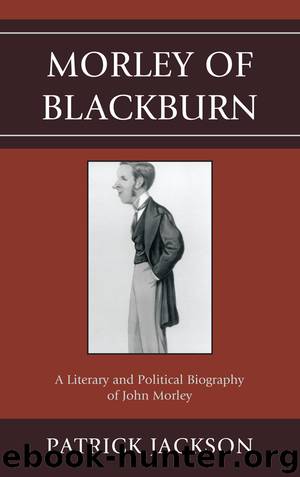
Morley of Blackburn by Patrick Jackson
Author:Patrick Jackson
Language: eng
Format: epub
Published: 2018-08-11T16:00:00+00:00
Punch Cartoon “Under the Mistletoe” December 24, 1898
From a position of semi-retirement, as he became more and more involved in writing the Gladstone biography, Morley provided advice and support to Campbell-Bannerman, who offered much tougher resistance to the imperialists than anyone had expected. The surprises began on February 24, 1899 when he voted for Morley’s motion denouncing the reconquest of the Sudan. Morley told his sister how he had “carried off the new leader into my lobby and left the Liberal jingoes well planted in a hole. It was rather an anxious moment until I knew how CB would go.” 186 For Harcourt, writing from Rome, this bold and successful stroke had been “a notable triumph for the party of resignation,” made even more delightful by the reported presence of Rosebery in the spectators’ gallery.187 Nevertheless Morley wrote considerately to Campbell-Bannerman acknowledging the “extreme delicacy” of his position and his courage in having voted as he did: “I will do my best not to multiply difficulties. This particular one could not be avoided, and I was sorry for it.” 188 In his speech Morley had conceded that Kitchener had shown great military skill, although the rather exaggerated language applied to him would “leave me no adjective, if ever I should want one, to describe Napoleon Bonaparte, or Alexander the Great, or a Duke of Wellington.” However, the reconquest had been undertaken without any clear objective. Kitchener had been appointed to govern the vast territory jointly on behalf of Egypt and Britain, and Morley pressed for further details of such an unprecedented arrangement. Unlike India, Britain’s expanding African empire had no strong natural frontiers, and it could be maintained only at enormous expense. At the next general election this expenditure might be a key issue, and he suggested that a jingo could be defined as a statesman whose policies cost £50 million a year at a time of profound European peace. Broderick, the secretary of state for war, congratulated Morley on a courageous speech. This was the first of only two speeches by Morley during the 1899 session, the other being on July 5 when he opposed a motion proposing a grant of £30,000 to Kitchener. After the capture of Khartoum the body of the Mahdi had been exhumed and decapitated, and Morley said that it would be a bad day for the House if such “ignoble proceedings” came to be regarded as trivial: “you send your soldiers to civilise savages. Take care the savages do not barbarise your soldiers.” Balfour defended Kitchener’s view that it was essential to undermine the basis of the Mahdi’s spiritual authority, commenting sarcastically that it was difficult to imagine Morley having to deal with such a practical dilemma. C. P. Scott, the great editor of the Manchester Guardian, then declared that the only thing more deplorable than “the perpetration of these barbarities . . . is that they should be defended by the Leader of the House.”
By the end of 1899 political attention had moved
Download
This site does not store any files on its server. We only index and link to content provided by other sites. Please contact the content providers to delete copyright contents if any and email us, we'll remove relevant links or contents immediately.
Cecilia; Or, Memoirs of an Heiress — Volume 2 by Fanny Burney(31956)
Cecilia; Or, Memoirs of an Heiress — Volume 3 by Fanny Burney(31941)
Fanny Burney by Claire Harman(26602)
We're Going to Need More Wine by Gabrielle Union(19046)
Plagued by Fire by Paul Hendrickson(17412)
All the Missing Girls by Megan Miranda(16023)
Cat's cradle by Kurt Vonnegut(15351)
For the Love of Europe by Rick Steves(14121)
Bombshells: Glamour Girls of a Lifetime by Sullivan Steve(14073)
Leonardo da Vinci by Walter Isaacson(13336)
4 3 2 1: A Novel by Paul Auster(12391)
The remains of the day by Kazuo Ishiguro(8998)
Adultolescence by Gabbie Hanna(8927)
Note to Self by Connor Franta(7670)
Diary of a Player by Brad Paisley(7577)
Giovanni's Room by James Baldwin(7346)
What Does This Button Do? by Bruce Dickinson(6207)
Ego Is the Enemy by Ryan Holiday(5447)
Born a Crime by Trevor Noah(5382)
